

Jice provides optical path medium stability for laser interferometers.
Release time:
2026-11-12
Stabilize the optical path and air environment to ensure the accuracy of the laser interferometer.
Laser interferometer data often do not match, and there is usually more than one cause; even when the instrument passes self‑checks, optical components are securely fastened, and alignment shows no looseness, there remains a frequently overlooked variable—the air through which the beam actually propagates.
With the same instrument and the same optical setup, measurements taken today and tomorrow do not match, and the repeatability between morning and afternoon sessions has noticeably deteriorated, yet no obvious hardware issues can be identified. Behind this often lies a change in the optical path medium.
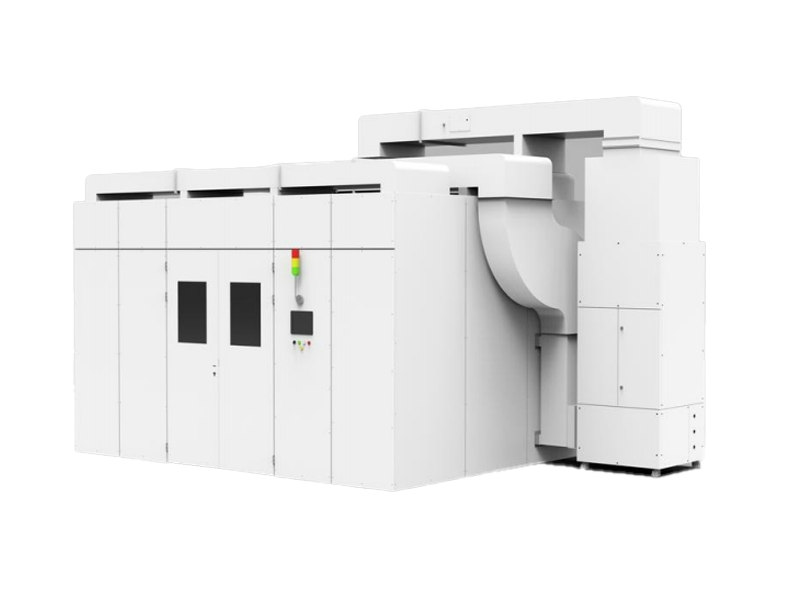
Jice High-Precision Environmental Control System UPECS The very issue to be addressed is this: ensuring the stability of the optical medium for the laser interferometer.

If the optical path medium is unstable, the interferometer cannot obtain accurate readings.
Laser interferometers use vacuum wavelengths as the standard, whereas wavelengths in air are determined by the refractive index of air, which varies slowly with temperature, atmospheric pressure, and humidity. Drift in time‑averaged values of temperature, pressure, and humidity can cause measurements of the same physical distance to yield different readings; moreover, during measurement, temperature gradients or airflow disturbances can lead to a non‑uniform distribution of the refractive index along the optical path, introducing additional fluctuations.
What’s even more troublesome is that it’s not easily detected on site. A room thermostat reading normal doesn’t mean the air along the optical path is stable; and no alarm from environmental sensors doesn’t guarantee that every segment of air traversed by the beam is free of local temperature variations or refractive-index gradients. Instability in the optical medium is precisely one of those subtle interferences that “instruments can’t detect, and data won’t match.”
Why can’t traditional methods stabilize the optical path medium?
Many interferometers today are equipped with environmental compensation features that use temperature, barometric pressure, and humidity sensors to correct the refractive index in real time. This feature is useful, but it has a structural limitation: its compensation is based on The optical path medium is uniform and stable. This is based on the premise that sensors measure only the specific “point” where they are located, whereas a laser beam traverses an entire optical path. If temperature gradients or localized airflows exist along the path, a single-point sensor cannot reconstruct the medium’s state across the whole path. The compensation algorithm corrects for a “representative point” rather than the complete path actually experienced by the beam, and it cannot track rapid airflow disturbances.
Maintaining constant temperature and humidity throughout the entire laboratory is another common approach. While this direction is not wrong, the control volume is too large and the control boundaries are too distant. Room-level systems focus on “how stable the room is,” whereas an interferometer is truly sensitive to “how stable the layer of air through which the beam travels is.” Control systems for the whole room often struggle to be finely tuned around the interferometer’s actual optical path and localized heat sources; conventional air conditioning, in its effort to maintain uniform room temperature, increases ventilation, and if airflow is poorly designed, it can instead create new turbulent disturbances near the optical path. As a result, although the room’s overall performance metrics may appear satisfactory, the medium through which light propagates remains inadequately stabilized, and the interferometer’s long-term repeatability does not improve accordingly.
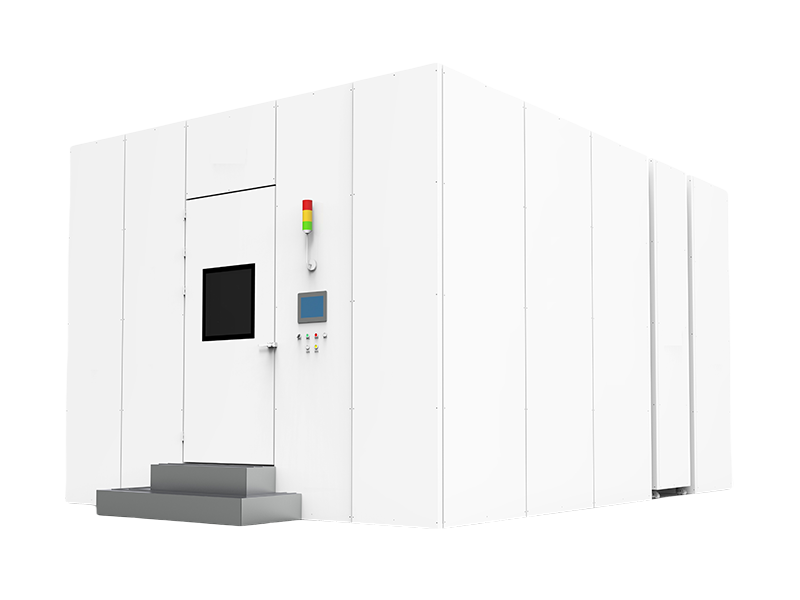
High-Precision Environmental Control System UPECS: Stabilizes the optical path medium adjacent to the light beam.
The concept behind the high-precision environmental control system UPECS is not to make the entire laboratory more complex, but rather to confine the control boundaries to the optical path itself, creating a locally controlled microenvironment around the actual air layer through which the beam passes.
Its localized air-bath module employs a low‑velocity airflow that has been current‑uniformed to pass through the optical path area in a controlled manner, carrying away equipment heat while preventing direct impingement of the airflow on optical components and the measurement beam path. Compared with whole‑room temperature and humidity control, the high‑precision environmental control system UPECS operates on a smaller scale; its airflow configuration can be tailored to follow the interferometer’s actual beam path and heat‑generating locations. The goal is to achieve lower temperature gradients and reduced airflow disturbances in the regions traversed by the optical beam—stabilizing the optical medium itself, rather than merely the numerical readouts displayed on the room walls.
In terms of control performance, the high-precision environmental control system UPECS achieves temperature stability as tight as ±0.002℃, humidity stability as precise as ±0.1%RH, and cleanliness up to ISO Class 1. Moreover, it can be custom-configured to meet the specific requirements of different interferometer setups—accounting for their optical path architectures, heat distributions, and installation constraints—ensuring that the local microenvironment precisely matches the actual measurement conditions, rather than forcing the equipment to conform to a fixed set of parameters. 。
For interferometer users, by means of Jice High-Precision Environmental Control System UPECS, Environmental control is no longer located far from the optical path; instead, it is implemented directly along the beam path. Rather than relying on a single-point sensor to “infer” the state of the entire optical path, the air in the region traversed by the beam is stabilized, ensuring that the interferometer’s repeatability is no longer compromised by fluctuations in external atmospheric conditions.




Here is the title one h1 placeholder text
More news

Service Hotline
E-mail:info@jicenj.com
Address: Block D, Tengfei Building, 88 Jiangmiao Road, Yanchuang Garden, Jiangbei New District, Nanjing City
Copyright © 2024 JICE(Nanjing) Technology Co., LTD